
What this page covers
The manuscript for this study has been submitted. Until it is published, this page reports only what is already public: the trial registry entry (UMIN000056162) and our symposium abstract for the 28th World Congress of the International College of Psychosomatic Medicine (ICPM 2026). Layer-by-layer values, confidence intervals, statistical analysis, blood markers and figures will be posted as soon as the paper appears.
Participants and design
A single-centre, randomised, participant-blinded, two-period crossover pilot study in 20 healthy men. Each participant received both force conditions, separated by 7 days.
| Item | Public registry information |
|---|---|
| Registration | UMIN000056162 — Analysis of myokine dynamics due to relaxation of the oblique abdominal muscles |
| Participants | 20 healthy men; eligibility: age 20–39 years, BMI 18.5–25 |
| Comparison | 4.9 N versus 0.49 N; 10 minutes each. Position, anatomical region, practitioner contact, trunk movement, contact sequence and duration matched. |
| Design | Randomised crossover; participants blinded; dose comparison |
| Registered primary outcome | Serum concentrations of 15 myokines |
| Registered secondary outcomes | Ultrasound assessment of lateral abdominal-wall tissue stiffness; serum myoglobin. Myoglobin was added in protocol version 1.2, dated 17 April 2025. |
| Principal investigator | Haruka Amitani, Department of Psychosomatic Internal Medicine, Kagoshima University Graduate School of Medical and Dental Sciences |
| Co-sponsor | Japan Health Organization |
Intervention and measurements
The lateral abdominal wall received a 10-minute 4.9 N Kanshoho intervention and, on a separate day, a movement-matched 0.49 N control. Kanshoho combines gentle focal pressure with guided movement.
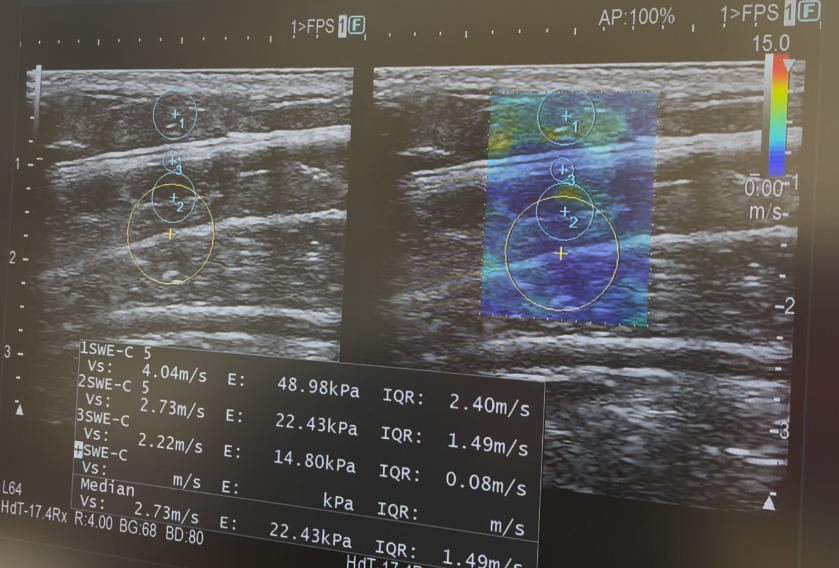
Shear wave elastography (SWE) assessed four layers — subcutaneous fat, the superficial fascial interface, the external oblique, and the deep myofascial interface between the external and internal oblique — before, immediately after and 15 minutes after each procedure. Serum myoglobin and candidate myokine-related proteins were measured acutely.
Which layers were measured
Skin surface ↓ deep
The elastography screen
Public results in brief
The registry and symposium abstract report a larger reduction in shear wave speed after 4.9 N than after the movement-matched 0.49 N procedure. The largest reported difference was at the deep interface between the external and internal oblique muscles.
| Outcome | Immediately after | 15 minutes after |
|---|---|---|
| Deep myofascial interface: median between-condition difference in SWS reduction | 0.610 m/s | 0.780 m/s |
These values describe the difference in reduction between the two procedures. The external oblique changed in the same direction; smaller changes were reported in subcutaneous fat and at the superficial fascial interface.
The public registry describes the primary serum-protein panel as exploratory, with assay censoring and variable interpretability. Confirmatory evaluation of treatment-specific protein responses remains a goal for follow-up studies; the present measurements help refine assays and hypotheses.
The public summary reports no acute treatment-specific rise in serum myoglobin and no procedure-related adverse events. Clinical follow-up and systematic adverse-event collection remain part of the design of further studies.
Sources: UMIN000056162 results summary and symposium abstract D, ICPM 2026. Full analyses and study figures will be added after journal publication.
Scope and next steps
Read together with the published case report, the abstract argues that low-force myofascial interventions deserve controlled evaluation in people who are vulnerable to post-exertional malaise. See the Long COVID / ME/CFS case
Research direction
We would like to repeat the measurement with several certified practitioners and independent sonographers under harmonised force and imaging settings, follow the response beyond 15 minutes, and establish a suitable interval between sessions. Extending the work to women, older adults and patients — and relating SWE to interlayer sliding and muscle activity — are natural next steps.
Ethics, registration and organisation
Ethics review: Kagoshima University Hospital (approved 17 September 2024). Registration: UMIN000056162, registered 15 November 2024; enrolment began on 6 November 2024, so the trial was registered retrospectively, 9 days after the first enrolment.
Responsible organisation: Department of Psychosomatic Internal Medicine, Kagoshima University Graduate School of Medical and Dental Sciences. Funding/co-sponsor: Japan Health Organization. The registry also lists an ultrasound-system loan from FUJIFILM Healthcare Corporation. Team, funding and competing interests →
Sources
- UMIN-CTR clinical trial registry: UMIN000056162
- Abstract D: Softening of the deep myofascial interface after a low-force 4.9 N manual intervention: implications for Long COVID/ME/CFS. Symposium, ICPM 2026 (Fukuoka). Relates the study in 20 healthy men to the published case report. Presented by Haruka Amitani, 25 September 2026, symposium DSY11-2. Official programme
- Paper: submitted. Bibliographic details and full results will be added on publication.
Sections marked “Research direction” describe hypotheses and proposed studies for discussion with collaborators. Observations are presented with their participants, methods and sources.
Last updated: 21 September 2026