
A technique described in researchable terms
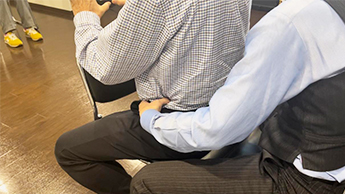
Kanshoho was developed in Japan in 2007 by Takashi Sakato. The practitioner applies a force of about 5.0 N through a small contact area, while the person receiving it makes small movements of their own. In publications it is described as a low-pressure muscle relaxation technique; on this site we also call it a low-force manual intervention. Each study specifies the body site, contact size, load, duration and movement.
We describe force in newtons and specify contact size separately. This makes the intervention easier to reproduce and compare across settings. Our published narrative review discusses its relationship to other manual therapies.
The recent lateral abdominal-wall study used a target load of approximately 5.0 N (reported as 4.9 N in the study), compared with a movement-matched 0.49 N control for 10 minutes. The manuscript has been submitted; the study page summarises the public registry and symposium abstract.
Technique and measurement conditions in detail
Three things to specify
- 01Contact
Body site, fingertip or instrument tip, and the size of the contact.
- 02Small active movement
Direction and range of the movement the person performs, and its duration.
- 03Measure before and after
Same posture and measurement settings on both occasions.
Early papers use the name “Kin-Kanshoho”. This site uses “Kanshoho” throughout and gives paper titles as published.
What we want to find out
| Research question | What is assessed |
|---|---|
| Under which conditions does the local response change? | Load, contact diameter and movement against muscle hardness and shear wave speed |
| Is the tissue response related to blood markers? | Short-term biochemical and metabolic indices against mechanical measurements of the tissue |
| Does it lead to changes that matter to patients? | Pain, function, range of motion, fatigue and daily life, with follow-up |
What has been observed, and what we want to explain
Studies measuring muscle hardness and shear wave speed run alongside studies following pain, function and fatigue. For each we state the participants, the comparison and the observation period, so that basic and clinical findings can be read together.
U.S. patent: a development milestone
A U.S. patent relating to the Kanshoho method and an assistance system was granted on 28 December 2021: US 11,207,238 B2. The inventor is Takashi Sakato; the granted document lists PACURE, INC. as applicant and assignee.
Method for causing relaxation of a muscle and a system for assisting a person in executing the same method.
The mechanism described in the patent reflects the developer’s working hypotheses at the time of filing. Our current hypotheses and proposed tests, including tissue mechanics and sensory input, are set out on the Mechanisms page.
This section documents the method’s development and intellectual property. The research pages present empirical findings with their study designs, participants and sources.
Patent record · Granted U.S. patent (PDF) · Intellectual property and disclosures →
Seeing the technique
A video of the technique being performed is available as supplementary material to the 2024 case report in Medicine (Video S1 ). Demonstration videos by the developer are in Japanese: YouTube channel . For study results, please rely on the methods, results and sources on each study page.
Sources
- Sugimoto S, Sakato T, Nakayama T, et al. Effect of Kanshoho on lumbar muscle tone [in Japanese]. Journal of Physical Therapy Fundamentals. 2025;28(1):32–38. doi:10.24780/jjptf.JJPTF_2023-17
- Sakato T, Amitani H. The muscle relaxation effects of gentle, focal load (4.9–7.4 N) with a narrow contact area: a narrative review of Kanshoho and conventional manual therapies. Cureus. 2025;17(8):e89646. doi:10.7759/cureus.89646
- Amitani H, Nishi R, Fukumoto T, et al. Severe fibromyalgia alleviated by the unique muscle relaxation method of applying low force: a case report. Medicine. 2024;103(16):e37929. doi:10.1097/MD.0000000000037929
- Study A (submitted manuscript): shear wave elastography of the lateral abdominal wall in 20 healthy men, randomised crossover pilot study. Trial registration UMIN000056162. This site reports only what is public in the registry and in our symposium abstract for the 28th World Congress of the International College of Psychosomatic Medicine (ICPM 2026, Fukuoka). Full details will be added when the paper is published.
- U.S. patent US 11,207,238 B2. Granted 28 December 2021. Inventor: Takashi Sakato. Official granted patent document (PDF)
Sections marked “Research direction” describe hypotheses and proposed studies for discussion with collaborators. Observations are presented with their participants, methods and sources.
Last updated: 21 September 2026