
Intervention conditions by study
| Study | Intervention and control | Time points |
|---|---|---|
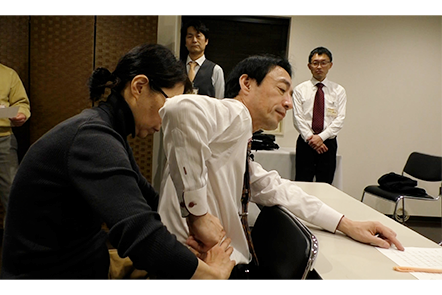
| Load, contact size and muscle hardness | Seated, side-bending. No load / 2.5 / 4.9 / 7.4 / 9.8 N (250–1,000 g in the paper); tip diameter 1 / 2 / 3 cm. | Before and after |
| Layer-specific SWE | 4.9 N versus 0.49 N. Ten minutes, movement and duration matched. Crossover with a 7-day interval. (Manuscript submitted.) | SWE: before, immediately after, 15 min |
| Chronic whiplash-associated disorder | Single session to the neck and shoulder girdle at about 4.9 N, up to 20 minutes, ending earlier if pain resolved. | Before, immediately after, 7 days, 28 days, 3 and 6 months |
Procedures are set to suit the participants and the aim of each study. Stating the load and the measurement together lets findings be carried into the next comparison.
Force: nominal values and notation
In general descriptions we use approximately 5.0 N. We report the applied force and contact diameter separately, so that both the magnitude and distribution of loading can be understood. Study-specific values, including 4.9 N, 7.4 N and 0.49 N, retain the precision used in their sources.
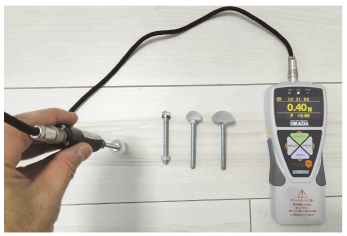
In the whiplash study, variation in applied force was checked with a digital force gauge before the session. The loads reported are therefore target values based on calibration beforehand. Continuous force recording during the session would raise reproducibility further and is a topic we would like to develop with partners.
What each measurement tells us
| Measurement | What it shows | Conditions that make it interpretable |
|---|---|---|
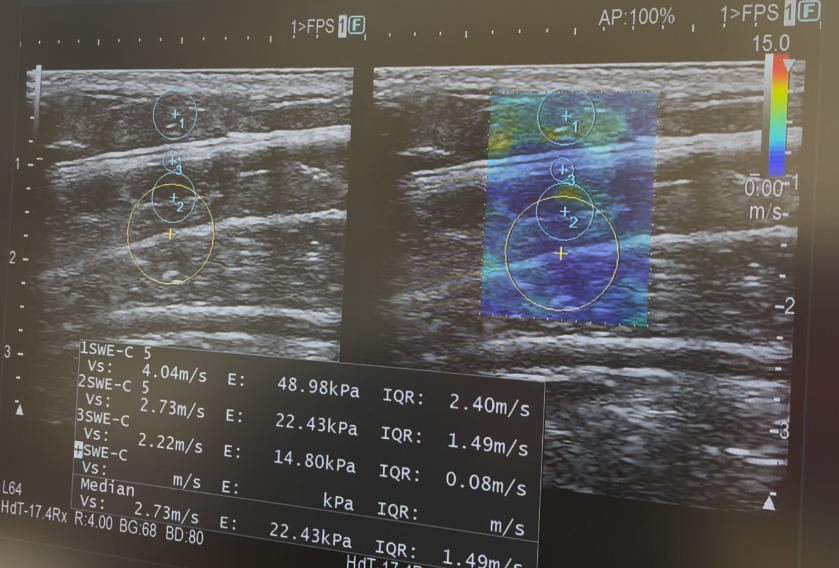
| SWE: shear wave speed (m/s) | Change in the mechanical state of a defined region | Harmonise posture, breathing, probe pressure, depth and tissue orientation; combine with structural imaging. |
| Muscle hardness meter | Change in resistance to indentation at the measurement site | Same device, posture and contact conditions, so that studies can be compared and repeatability assessed. |
| B-mode tissue thickness | Thickness of a layer defined on the image | Describes shape; combined with SWE and muscle activity to study how relaxation comes about. |
| VAS, NDI, ROM | Pain, disability and range of motion | Separate self-report from assessor measurement; give the change, the denominator and the follow-up period. |
Muscle hardness meter
The 2025 dose-parameter study and the 2012 low-back-pain study measured resistance to indentation with a hand-held hardness meter (the 2012 study used a PEK-1). Readings are on a device-specific scale. We therefore state the principle and unit of each instrument — hardness meter, SWE shear wave speed, muscle activity — so that tissue softness can be understood from several angles.
Layers assessed with SWE
In the abdominal-wall study, shear wave elastography assessed four layers — subcutaneous fat, the superficial fascial interface, the external oblique, and the deep myofascial interface between the external and internal oblique — before, immediately after and 15 minutes after each procedure.
The manuscript has been submitted. Device, probe, measurement points, acquisition settings and analysis will be added here on publication.
Items to harmonise in a replication
Research direction
- Eligibility criteria, concurrent treatment, meals, exercise and time of day.
- Treated site, posture, force, contact diameter, movement, duration and practitioner experience.
- Control condition, allocation of order, assessor blinding, interval and carry-over.
- Instruments, acquisition settings, number of repeats, primary outcome and analysis plan.
- Safety records covering comfort, changes in condition, continuation in the study, and symptoms that appear later.
Sources
- Sugimoto S, Sakato T, Nakayama T, et al. Effect of Kanshoho on lumbar muscle tone [in Japanese]. Journal of Physical Therapy Fundamentals. 2025;28(1):32–38. doi:10.24780/jjptf.JJPTF_2023-17
- Sakaguchi H, Sakato T, Yamamoto K, et al. The effect of Kanshoho on low back pain (lumbago) [in Japanese]. Japanese Journal of Integrative Medicine. 2012;5(1):62–67 (PDF)
- Study A (submitted manuscript): shear wave elastography of the lateral abdominal wall in 20 healthy men, randomised crossover pilot study. Trial registration UMIN000056162. This site reports only what is public in the registry and in our symposium abstract for the 28th World Congress of the International College of Psychosomatic Medicine (ICPM 2026, Fukuoka). Full details will be added when the paper is published.
- Manuscript B (presented at conferences; unpublished manuscript): Sakato T, Shin Y, Itai Y, Amitani H. Immediate and mid-term effects of Kanshoho in patients with chronic whiplash-associated disorders: a prospective single-arm pilot study. Presented at the 55th Annual Meeting of the Japanese Society for the Study of Chronic Pain and the 35th Annual Meeting of the Japanese Society of Pathophysiology (both 2026).
Sections marked “Research direction” describe hypotheses and proposed studies for discussion with collaborators. Observations are presented with their participants, methods and sources.
Last updated: 21 September 2026